FETA PDO: PROVENANCE THE BUYER CAN VERIFY
The growth in UK cheese is no longer coming from the most familiar part of the fixture. AHDB analysis of NIQ Homescan data for the 52 weeks ending 04/10/2025 shows cows’ cheese volumes up 1.6% year on year and spend up 5.3%. Cheddar remains the largest part of the category, accounting for 45.2% of volumes, yet its own volume growth was just 0.1%. Speciality and continental cheese grew by 3.2%.
That is the trading context in which FETA PDO enters 2026. This is not another white cheese competing for chiller space. It is a protected Greek product whose commercial strength rests on precisely the attributes now doing more of the work in premium dairy: origin, method, legal protection and a recognisable eating occasion.
WHAT THE PDO ACTUALLY GUARANTEES
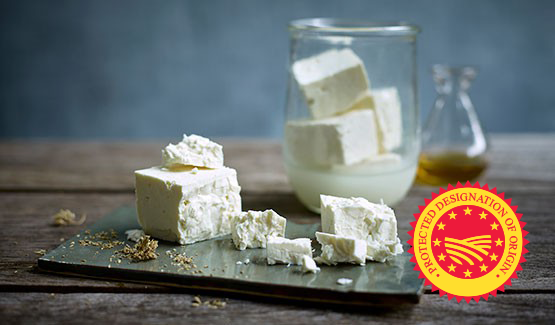
Protected Designation of Origin status matters because it gives buyers a specification rather than a slogan. The European Commission’s geographical indication scheme protects the names of products that originate in a defined region and carry qualities or a reputation linked to that territory. In the case of FETA PDO, the name is tied to Greece, to defined production areas and to traditional milk supply and processing rules.
FETA PDO may be produced only in specified regions of Greece, from sheep’s milk or a mixture of sheep’s milk and up to 30% goat’s milk. The milk must come from breeds traditionally reared in those areas. The specification prohibits the casual substitution that has long complicated the wider white-cheese market. For UK retailers and foodservice operators, that clarity has value: it lets the buyer distinguish a certified product from lower-cost feta-style cheeses made elsewhere and from different milk systems.
DEMAND IS ESTABLISHED, BUT SUPPLY NEEDS WATCHING
Greek trade reporting in May 2026 put Greece’s 2025 feta exports at 105,000 tonnes, up from 97,000 tonnes in 2024, drawn from total production of about 140,000 tonnes. The same reporting put UK off-take at around 12,500 tonnes and Italy at around 15,500 tonnes. These figures confirm the UK’s significance as a feta market, though they should be treated as trade-reported rather than a substitute for official customs data.
The supply picture is less comfortable. Sheep and goat disease outbreaks in Greece have raised concerns about milk availability for the 2025/26 season, and Greek media and trade sources warn that production growth may be constrained. The editorial point for buyers is practical: secure relationships early, confirm that the product is genuine PDO, and stop treating feta as an interchangeable commodity line.
HOW TO SELL THE STORY WITHOUT OVERCLAIMING
FETA PDO works hardest where its origin is made visible. The product earns the right to speak through geography, breed, milk composition, maturation and culinary use. In retail, that supports premium fixture placement, clear PDO labelling and recipe-led shopper education. In foodservice, it gives chefs a reliable point of difference across salads, pastries, small plates, grilled formats and Eastern Mediterranean menus.
The danger is to over-romanticise it. Feta does not need inflated language. It needs accurate provenance, firm supply discipline and a sharper distinction between certified FETA PDO and generic white cheese. In a market where speciality cheese is outpacing the category average, that distinction is no longer a minor labelling point. It is the commercial case.
For more information visit stand 1405 at the ICDA EXPO on the 24/25 June in Stafford.
SOURCE NOTE FOR PRODUCTION
- AHDB, Dairy retail performance, 52 w/e 04/10/2025; AHDB October 2025 Dairy Market Review: cows’ cheese volume +1.6%, spend +5.3%, Cheddar 45.2% share and +0.1%, speciality/continental +3.2%. VERIFIED against AHDB.
- European Commission FETA PDO page and EU geographical indications guidance; EUR-Lex Regulation (EC) No 1829/2002. Milk composition (up to 30% goat’s milk) VERIFIED.
- Greek trade reporting (e.g. To Vima, May 2026) on 2025 feta exports of 105,000 tonnes, 2024 of 97,000 tonnes, production ~140,000 tonnes, UK ~12,500 tonnes, Italy ~15,500 tonnes. Tonnages corroborated across multiple trade/news outlets; retain as trade reporting, not official Eurostat statistics.
More news and insight